


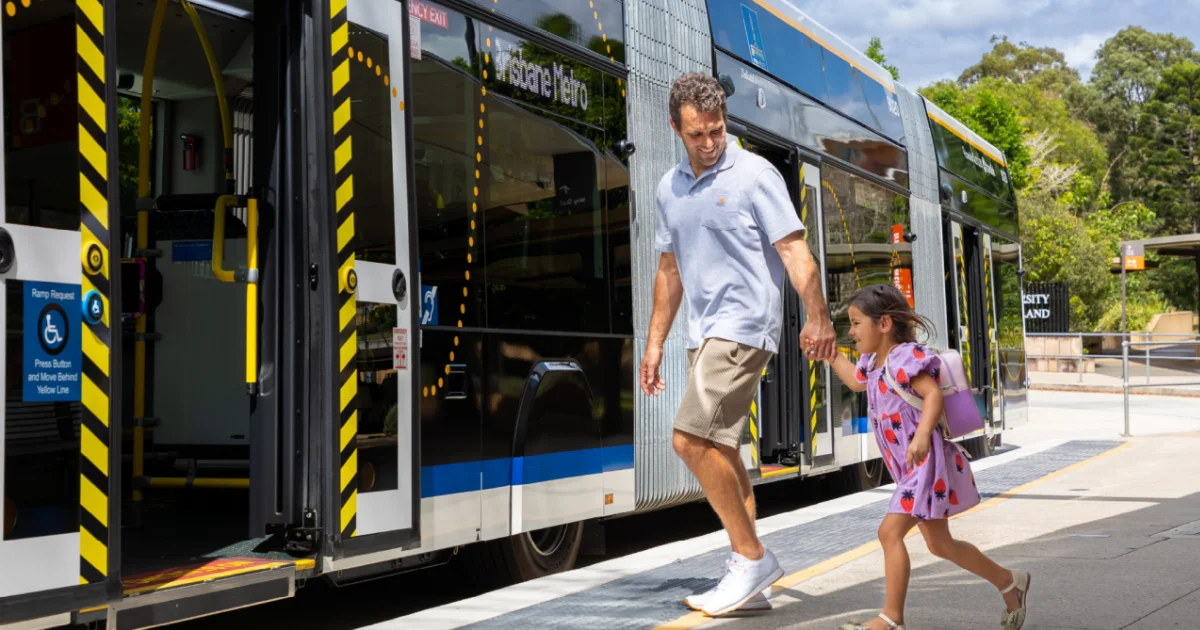
Brisbane could soon see a new fleet of electric buses, known as Metro Gliders, linking suburbs to the city’s high-frequency public transport network. A $50 million rapid business case has been launched to investigate four potential Metro extension routes, reaching Carseldine, Springwood, Capalaba, and the airport.
Read: Brisbane Metro Expansion: New Stations Planned for Carseldine and Beyond
Metro Gliders are smaller, more agile electric buses modelled after the Brisbane Metro. They are designed to act as suburban connectors, moving passengers from local streets onto main Metro lines and train stations. Their compact size allows them to navigate corridors that larger Metros cannot, improving access to high-frequency routes.


RACQ has urged the rollout of Metro Glider services as a practical way to expand public transport coverage. The organisation supports these buses as a means to help ease congestion and link more communities to the city’s broader transport network. Metro Gliders could complement existing bus and train services, acting as feeders that make it easier for residents to access high-frequency routes.
An SEQ Gliders plan suggests that the buses could operate along major corridors such as Lutwyche, South Pine, Samford, Waterworks, Ipswich, Logan, Sandgate, and Wynnum roads, as well as key city arteries like the Centenary Motorway and Coronation Drive. Metro Gliders could also extend to outer areas, including Ipswich, Redcliffe, Caboolture, and the Gold Coast.

Metro Gliders could be deployed more rapidly than larger Metro extensions because they primarily require upgrades to existing road networks rather than entirely new busways. This approach allows faster deployment compared with full-scale Metro infrastructure.

Early Metro services have shown strong uptake. The M2 route between UQ Lakes and the RBWH, launched in January, has recorded over 3.3 million trips, while the M1 service connecting Eight Mile Plains and Roma Street, which began in June, has carried nearly one million passengers.


RACQ research has highlighted that congestion and limited transport options remain key concerns for residents. The organisation has emphasised that better planning and strategic expansion of public transport are important to meet the needs of a growing population. Metro Gliders are identified as a solution to help fill gaps in the current network, improving access and connections to the city.
By connecting suburban areas to city hubs and existing train stations, Metro Gliders could provide more options for commuting and help reduce pressure on roads. Communities from Carseldine to Capalaba could see improved access to public transport through these smaller, more agile buses.
Read: Next Stage of Upgrades at The Green in Carseldine Village Set to Begin in November
With the $50 million business case underway, Brisbane’s public transport network could become more integrated and better connected, with Metro Gliders serving as an important addition to the city’s transport options.
Published 15-October-2025