



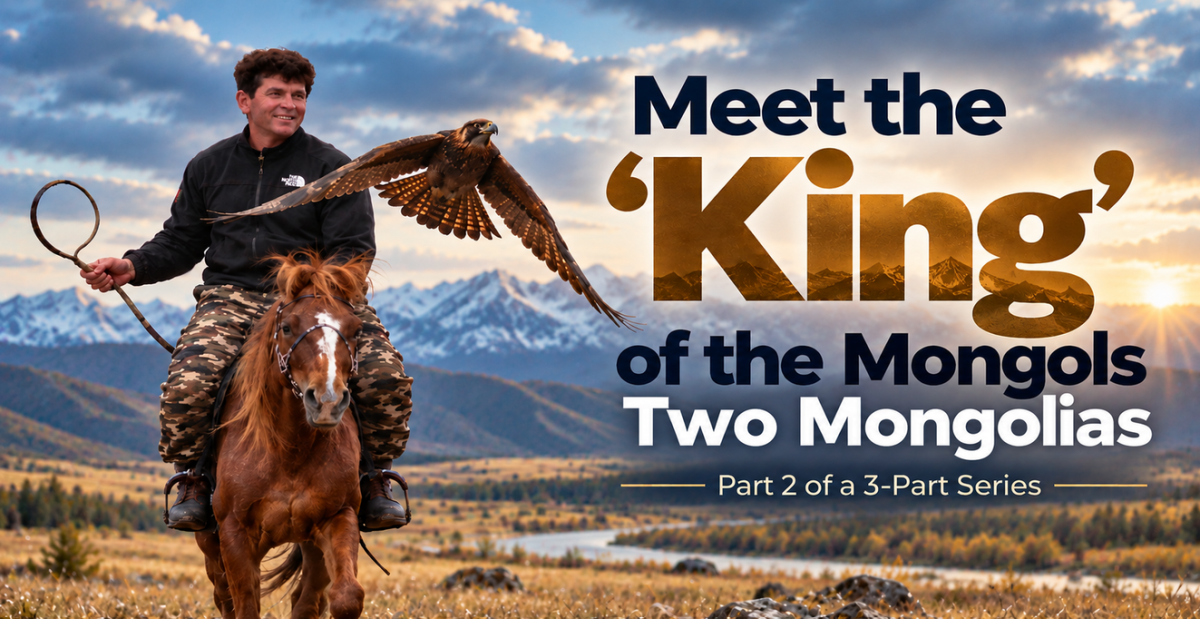
This is Part 2 of a 3-Part Series
For more than 20 years, Brisbane man Jeff King has lived between two Mongolias. One has high-rise apartments, supermarkets and traffic so bad he often walks. In the other, his wife’s family can pack up their home and move with their animals — until the terrain gets too rough and the camels take over.
Jeff first went to Mongolia in 2003 and later married into a traditional herding family. His life since has taken him regularly between the capital, Ulaanbaatar, and the vast countryside where his wife’s relatives still raise sheep, goats, cattle and horses.

The family lived about three kilometres from central Ulaanbaatar, and Jeff had little enthusiasm for driving there. “We bought a car, but we didn’t buy it to drive in the city,” he said. “We bought it to get out.”
Read: Meet the “King” of the Mongols Living in Brisbane — Part 1 of a 3-Part Series
When the family moves, the house goes too
His wife’s relatives don’t simply wander across the countryside. Families have established places for different seasons, typically making four major moves through the year, although grazing conditions can push that to eight or even 10.

The ger goes with them.
For a family accustomed to the job, Jeff said, the circular felt-covered home can be dismantled in about an hour. Trucks have taken over much of the heavy carrying, but only for as long as the terrain allows. In mountain country where a vehicle can go no further, camels can carry the ger and the family’s possessions for the rest of the journey.
Traditionally, Jeff said, a family could move its home and belongings with about five camels.


The scale of the livestock took some getting used to as well. His sister-in-law’s family can have more than 1,000 animals, roaming country without the paddocks and boundary fences familiar to Australians.
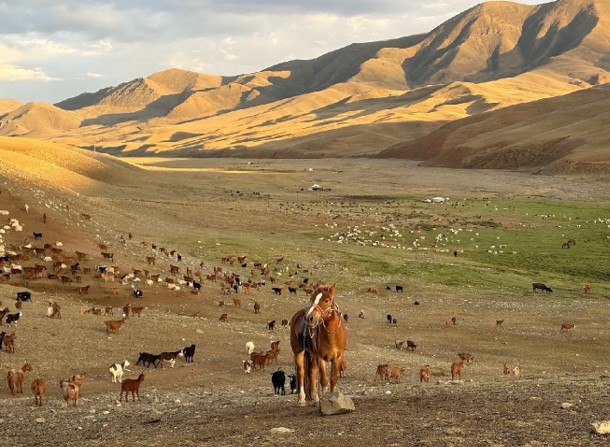
When different families’ sheep mingle, sorting them out might look impossible to an outsider. Jeff has watched herders recognise individual animals, know which lamb belongs to which ewe and separate mixed flocks. Their knowledge can stretch across generations of animals.
Even asking how many horses somebody owns comes with a rule Jeff learnt not to break. Asking directly is considered bad luck.
There is, however, a workaround: ask how many stallions the herder has. With roughly 20 mares to a stallion, Jeff said, the answer gives you a fair idea without asking the question you’re not supposed to ask.
Horses remain part of working life, although motorbikes now do plenty of the work as well. Trucks carry families between camps and smartphones have changed how people communicate across enormous distances.
Jeff has seen how quickly news can travel through communities that look isolated on a map. Phones and internet make that easier now, but even before them, information moved. Somebody would hear something, get on a motorbike and carry the news onwards.
Winter changes the equation again.
Temperatures around -30°C are unremarkable enough in Jeff’s experience, while the mercury can fall into the -40s. Families spread farther apart as grazing becomes scarcer, and journeys that are straightforward in summer become much more serious.
Hospitality matters in those conditions. A traveller arriving at an isolated ger can expect tea, food and shelter — things that take on rather more importance when it is 40 degrees below freezing outside.
Jeff generally saved his longer journeys for the warmer months. For a time, some of them were made with a vehicle full of books.
A library that came to the readers
Mongolia had high literacy from the Soviet era, Jeff said, but access to books could be difficult for families living far from population centres.
So the library travelled.
Jeff and his colleagues drove from family to family, leaving books and returning roughly a month later to exchange them. Among everything they carried, one title became the unexpected favourite: Jules Verne’s Around the World in Eighty Days.
Jeff took a camera with him too. He would photograph families, have the pictures printed and bring them back on subsequent visits, giving him another reason to return to the same people.
Over time, combinations that might initially have struck an Australian visitor as unusual became part of the scenery: a motorbike outside a ger, a smartphone in a herder’s pocket, or a truck carrying a home that might later have to be transferred to camels.
None of it seemed particularly unusual to Jeff’s children.
For Jeff, moving between these two Mongolias took years of learning. For his sons, there was never the same dividing line.
The apartment and the ger, Brisbane and Ulaanbaatar, English and Mongolian, city life and their mother’s herding family — all of it belonged to their childhood.
As the boys grew older, that raised a much harder question for Jeff and his wife: when your children belong to two countries, where is home?
The free community breakfast brings men together at Dale Farm in Fitzgibbon every four to eight weeks, with a guest speaker chosen for the uniqueness of their story.
Start: 6.30am–7am
Cost: Free
Who: Lads of all ages welcome
Also: Coffee van on site
NEXT: Part 3: Raising a Family Between Two Worlds
Published 15-September-2026